01 | A Beautiful Rendering Is the Easy Part—Keeping That Look in Production Is Not
When designers finalize the exterior look of a home appliance, they typically work through one path:
Color → Material → Texture → Gloss → Pattern
But once prototyping begins, the same question keeps coming up: why is there always a gap between the rendering and the physical product?
This is especially true of glass for home appliances—the same color and the same pattern, once they pass through the glass substrate, the enamel, and the surface treatment, can only be verified on the finished part.
So for a designer, a supplier’s core capability isn’t “whether they can make it.” It’s this:
Whether they can understand the design intent and reliably translate it into the finished product.
02 | Color: Start from a Pantone Code, Not “Close Enough”
Every established appliance brand has its own color system.
If a supplier can only offer a handful of fixed colors, the design space is limited from the start.
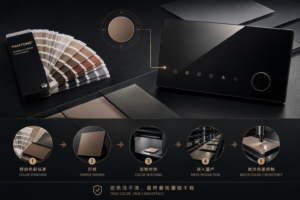
SuperVIG supports Pantone-based color matching: designers start the conversation from an exact color code instead of going back and forth over “a shade darker” or “a bit warmer.”
The color confirmation path is just as clear:
Provide the color standard → prototyping → color check against the physical sample → mass production
One more thing worth confirming during the prototyping stage: color variation between mass-production batches. Getting the color right is ultimately about batch-to-batch consistency—that’s the distance between “a sample that looks good” and “a product that looks good.”
03 | Pattern and Texture: Complex Decoration Isn’t the Barrier—Distortion Is
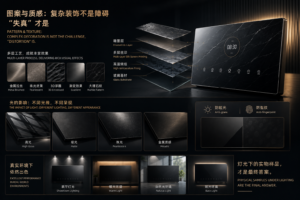
Appliance exteriors increasingly lean on material and texture: brushed metal, pearlescent, 3D embossed relief, soft-touch matte… getting these effects onto glass takes process capability, not imagination.
SuperVIG uses multi-layer screen printing + high-temperature firing: enamel inks are built up layer upon layer and fused into the substrate at high temperature, so gradients, marble veining, and brushed textures all come through with natural transitions.
And there’s one variable that’s easy to overlook: light.
The same dark panel—glossy, matte, pearlescent, or metallic—looks completely different under showroom lighting than under the natural light of a home. SuperVIG offers optional anti-glare and anti-fingerprint treatments that keep the panel clear and refined in every lighting environment.
That’s why a pattern should never be judged from a 2D rendering alone—the physical sample under real lighting is the final answer.
04 | Built to Last: The Design Has to Hold Up Across the Product’s Entire Lifecycle
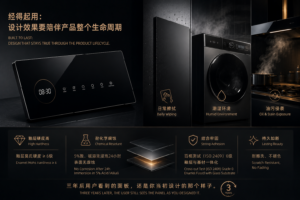
Designers focus on the visuals; users live with the everyday: refrigerator doors get wiped down daily, washer panels sit in damp conditions year after year, and kitchen appliances face grease head-on.
If the enamel layer isn’t hard enough, it wears from repeated wiping; if it doesn’t bond firmly, it eventually peels—no matter how good the design, it won’t survive a single product cycle.
Here are the performance benchmarks of SuperVIG glass for home appliances:
- Enamel layer hardness of Mohs 6 or higher; no surface corrosion after 24 hours of immersion in 5% acid and alkali solutions
- The color isn’t printed on the surface—it’s fired into the glass: cross-cut adhesion test (ISO 2409) rating of 0, with the enamel layer and the substrate fused as one, resistant to scrubbing and fading.
For designers, the confidence behind all of this comes down to one sentence:
Three years in, the panel your user sees still looks exactly the way you designed it.
05 | Cleanability: Dark, High-Gloss Finishes Make the Strongest Impression—and Show Every Smudge
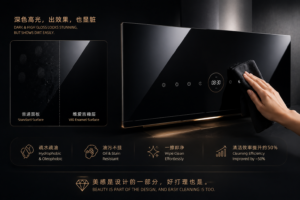
In a CMF proposal, dark, high-gloss, mirror-like surfaces draw the eye first—but they’re also the first to give away fingerprints and grease.
SuperVIG’s enamel surface is dense and smooth, and with hydrophobic and oleophobic treatment, grease won’t cling and wipes away in a single pass—according to the manufacturer’s side-by-side testing, cleaning efficiency improves by about 50%.
When you choose a dark, high-gloss scheme, factor the everyday cleaning experience into the decision—aesthetics are part of the design, and so is easy upkeep.
06 | Leave the Design in the Rendering, or Make It a Product?
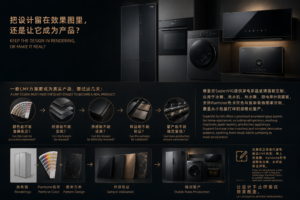
For a CMF proposal to become a real product, it has to clear these gates:
Can the color be reproduced accurately? Can the texture be achieved? Can the finish be faithfully restored? Can the sample prove it? Can mass production replicate it consistently?
SuperVIG provides custom glass panels for home appliances, used on the exterior panels of refrigerators, washing machines, water heaters, and kitchen appliances, with support for Pantone-based color matching and custom decorative patterns, covering everything from small-batch prototyping to full-scale production.
If you’re developing the CMF for a new appliance, bring your renderings, Pantone codes, or pattern designs and start with sample verification.
Let the design live beyond the rendering.