A Climate- and Scenario-Based Selection Checklist for High-Performance Insulating Windows | By SuperVIG
When renovating or building, the window and door budget is often one of the last items people take seriously.
Structural work, MEP systems, kitchens and bathrooms, furnishings—every category gets attention. Windows and doors, however, are often treated as a case of “good enough.”
Then you move in.
The first summer, the south-facing living room is still hot and stuffy with the AC running. The first winter, the north-facing bedroom window feels drafty. By year three, the utility bills start to look wrong. By year five, you finally realize: the problem is that window.
But by then, it’s already hard to change.
This article is a checklist SuperVIG wants to give you before that happens.
It’s not about buying the most expensive option. It’s about understanding what you truly need before renovation and selection—then making a decision you won’t regret.
I. First, Understand: What Kind of “Thermal Environment” Do Your Windows Face?
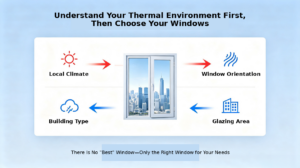
Many people choose windows by asking, “Which brand is best?” or “Which glass is best?”
But there is no absolute “best” window—only a window that is appropriate for your climate and building scenario.
The same vacuum glass can solve completely different problems in Harbin and Guangzhou. Likewise, the same Low-E insulating glass can feel very different in a south-facing floor-to-ceiling window versus a small north-facing window.
So the first step in selection is not looking at products—it is understanding your own thermal environment.
China’s Building Climate Zones: Which Zone Are You In?
According to China’s Code for Thermal Design of Civil Building, China is divided into five building climate zones:
| Climate Zone | Representative Cities | Main Challenges | Window Selection Priorities |
| Severe Cold Zone | Harbin, Changchun, Shenyang | Extremely cold winters; high heating energy demand | U-value first; as low as possible. High airtightness is required. |
| Cold Zone | Beijing, Tianjin, Xi’an, Jinan | Cold winters and hot summers—stress in both seasons | Balance U-value and g-value; thermal-bridge control in the frame is critical. |
| Hot Summer & Cold Winter Zone | Shanghai, Nanjing, Wuhan, Chengdu, Chongqing | Hot, humid summers and cold, damp winters; both cooling and heating are needed | Neither g-value nor U-value can be ignored; condensation risk must be considered. |
| Hot Summer & Warm Winter Zone | Guangzhou, Shenzhen, Fuzhou, Haikou | Long summers with strong solar radiation | Prioritize g-value; shading and ventilation are equally important. |
| Temperate Zone | Kunming, Guiyang, Lhasa | Relatively mild climate, but strong high-altitude solar radiation | Basic insulation is sufficient; some areas require attention to solar heat gain. |
The climate zone you are in determines the first priority in your window selection.
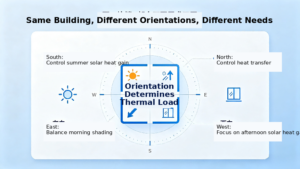
Orientation: The Same Building Can Have Completely Different Window Needs
Many people assume the same glass can be used throughout a home.
In reality, different orientations expose windows to very different thermal loads:
South-Facing Windows
- Winter: Direct sunlight can provide passive solar heat gain, helping with warmth.
- Summer: The sun is higher in the sky and direct exposure lasts longer, creating the greatest heat-gain pressure.
- Selection focus: Use a low g-value to control summer solar heat gain while maintaining good winter daylight.
North-Facing Windows
- Year-round: There is little direct sunlight; most daylight is diffuse.
- Winter: Indoor heat continuously escapes outdoors, making north-facing windows a major source of winter heat loss.
- Selection focus: Use a low U-value to reduce heat transfer, with daylight as a priority.
East-Facing Windows
- Morning: Low-angle direct sunlight can create significant heat gain in summer mornings.
- Afternoon: No direct sunlight, so thermal load is lower.
- Selection focus: Balance morning solar control with all-day daylight.
West-Facing Windows
- Afternoon: Low-angle direct sunlight makes summer afternoons the strongest period for heat gain.
- Morning: No direct sunlight.
- Selection focus: Focus on controlling afternoon solar heat gain; west-facing solar exposure is the most challenging here.
二、II. Selection Logic for Different Scenarios
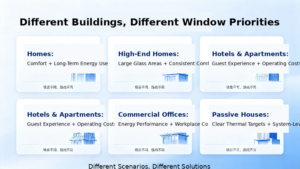
Scenario 1: Standard Urban Residence (Owner-Occupied, Long-Term Living)
What you should care about most: Comfort + Long-Term Energy Use
These two things matter more than “how much you save on the initial renovation.” Once the windows are installed, you’ll live with them for 10 or 20 years.
Basic Recommendation:
- Glass: Low-E insulating glass with an appropriately designed air cavity.
- Frames: Thermally broken aluminum or uPVC; confirm whole-window U-value data is available.
- Key focus: Choose a low g-value for south-facing windows and a low U-value for north-facing windows.
Upgrade Recommendation (for the following situations):
- You have large floor-to-ceiling windows or corner windows.
- Your city has strong, long-lasting summer sunlight.
- You have high expectations for indoor comfort.
- You plan to live there long term and care about energy bills over 10+ years.
Upgrade path: SuperVIG vacuum glass system paired with low-conductivity frame materials.
The whole-window U-value can reach a lower range, significantly reducing the “hot wall” feeling near windows in summer and largely eliminating the drafty cold feeling near windows in winter.
The core problem SuperVIG vacuum glass solves in this scenario is:
Making the area next to the window one of the most comfortable places in the home—instead of a place you avoid in summer or bundle up near in winter.
Scenario 2: High-End Homes, Villas, and Large Apartments
What you should care about most: Exceptional Comfort + Quality + Long-Term Stability
These projects typically have large areas of glazing, high expectations for indoor environmental quality, and owners who are sensitive to details.
Selection Recommendation:
- Glass: SuperVIG vacuum glass—prioritize it.
- Frames: Fiberglass composite frames or high-performance thermally broken aluminum, paired with carefully detailed installation.
- Key focus: Whole-window system coordination, rather than simply stacking premium components.
In this scenario, the value of SuperVIG vacuum glass is more than “better insulation.” It also delivers:
- More uniform indoor temperatures with large areas of glass, without obvious “hot zones” or “cold zones.”
- Higher interior glass-surface temperatures, extremely low condensation risk, and consistently clear, transparent glass.
- Stable long-term performance, without the pattern of being “great in year one, then worse by year five.”
Scenario 3: Hotels, Apartments, and Rental Properties
What you should care about most: Guest Comfort + Operating Energy Use + Long-Term Maintenance Cost
These buildings typically have long user stays, occupants who are sensitive to temperature changes, and energy costs that are a major part of long-term operating expenses.
Selection Recommendation:
- Guest rooms, restaurants, and other long-stay areas: prioritize the SuperVIG vacuum glass system.
- Corridors, lobbies, and other short-stay areas: high-performance Low-E insulating glass may be sufficient.
- Frames: Depending on the façade design and budget, choose thermally broken aluminum or fiberglass composite frames.
A cost calculation worth taking seriously:
Vacuum glass has a higher upfront cost than insulating glass, but:
- Lower AC and heating energy use means ongoing annual energy savings.
- Fewer occupant complaints (“the room is too hot” and “the window area is too cold” are among the most common hotel complaints).
- Stable long-term glass performance means lower maintenance and replacement costs.
Taken together, these factors often make SuperVIG vacuum glass a “spend more upfront, save more over time” choice for hotels and apartments.
Scenario 4: Office Buildings and Commercial Buildings
What you should care about most: Overall Energy Performance + Indoor Workplace Comfort
These buildings often have large glazed curtain walls. Windows and doors can account for a significant share of total heat loss, while indoor work environments still need to meet basic comfort expectations.
Selection Recommendation:
- Main façades (especially south and west): focus on controlling solar heat gain; prioritize g-value.
- North-facing façades: focus on heat transfer; prioritize U-value.
- Glass system: Based on the energy-efficiency target, choose between high-performance Low-E insulating glass and SuperVIG vacuum glass.
- Frames: Integrate with the overall curtain-wall system and ensure thermal bridges are properly controlled.
A common misconception:
Many commercial façade designs look only at optical glass properties (visible transmittance and reflectance) while overlooking thermal properties (U-value and g-value).
The result: The façade looks great, but areas near the curtain wall are hot in summer and cold in winter, affecting employee comfort and productivity while the HVAC system runs at high load for long periods.
For commercial projects, SuperVIG works with design teams on the overall thermal solution rather than simply providing a glass specification sheet.
Scenario 5: Passive House, Nearly Zero-Energy Buildings, and Green-Building Demonstration Projects
What you should care about most: Meeting Defined Thermal Targets + Long-Term Performance Stability
These projects have clear U-value targets and annual energy-use constraints, making windows and doors one of the core components for achieving the goals.
Selection Recommendation:
- Glass: SuperVIG vacuum glass—an option that should almost certainly be included in the shortlist.
- Frames: Fiberglass composite frames with carefully detailed installation.
- Key focus: Bring windows and doors into the thermal-design discussion early, rather than waiting until the procurement stage.
Why Get Involved Early?
Thermal design for Passive House and nearly zero-energy buildings is an optimization process for the entire system. Window and door U-values and g-values directly affect whole-building energy simulations.
If the window selection is finalized late, you may end up with a situation where “everything else is done right, but the windows drag the project down and the overall target cannot be met.”
For these projects, SuperVIG participates as a technical solutions provider in thermal-design discussions, helping ensure the window and door system genuinely supports the project’s overall energy-efficiency goals.
III. Selection Checklist: Follow the Steps and Avoid Pitfalls
Step 1: Confirm the Climate Zone and Orientation

- Which climate zone am I in? (Severe Cold / Cold / Hot Summer & Cold Winter / Hot Summer & Warm Winter / Temperate)
- What are the main orientations of my exterior windows? (South / North / East / West)
- How large are my windows? (Standard windows / Large floor-to-ceiling windows / Corner windows / Curtain wall)
Step 2: Set Your Priorities
Choose the two things you care about most from the four below:
- Indoor comfort (comfortable near the window—not too cold or too hot)
- Long-term energy control (electricity/heating bills over 10 or 20 years)
- Daylight performance (brightness, views, and natural-light quality)
- Upfront construction or renovation cost (one-time budget control)
Step 3: Match the Glass Path
Path A: High-Performance Low-E Insulating Glass
Best for: Relatively mild climates, smaller window areas, limited budgets, and basic needs for energy efficiency and comfort.
Selection Points:
- Confirm the glass has a Low-E coating—not standard insulating glass.
- Confirm the cavity thickness and gas-fill specification.
- Request the whole-window U-value, not just the center-of-glass U-value.
Path B: SuperVIG Vacuum Glass System
Best for: Larger window areas, harsh climates, higher expectations for long-term comfort and energy use, and projects such as Passive House buildings with defined thermal-performance requirements.
Selection Points:
- Confirm the vacuum level and long-term stability assurance.
- Confirm that the coating and vacuum-cavity configuration are properly matched.
- Request a complete whole-window system proposal, including frame recommendations.
- Confirm complete thermal test data—not just marketing specifications.
Step 4: Confirm the Frame Solution
Once the glass path is determined, the frame becomes a key factor that sets the lower limit of whole-window performance.
Three things you must clarify:
- What is the frame material? Aluminum alloy, thermally broken aluminum, uPVC, fiberglass composite, or wood?
- Is there a whole-window U-value test report? Not the glass— the entire window.
- Has the frame-and-glass combination been optimized for your scenario, or is it a standard configuration?
Step 5: Verify System Coordination
Use these three questions to verify whether the supplier is actually developing a solution rather than simply selling a product:
Question 1: Are the specifications you provided for the whole window or for a single piece of glass?
Question 2: Has this solution been optimized for my orientation and climate zone, or is it a standard configuration?
Question 3: Can you clearly explain why this glass is paired with this frame rather than another combination?
If they cannot clearly answer the third question, they are selling products—not developing a solution.
IV. One-Page Comparison: Which Solution Fits Your Scenario?
Your Situation Recommended Direction
━━━━━━━━━━━━━━━━━━━━━━━━━━━━━━━━━━━━━━━━━━━━━━━
Mild climate + small windows + limited budget → Low-E insulating glass, with a well-designed frame.
Mild climate + large windows → Seriously evaluate SuperVIG vacuum glass.
Harsh climate (Severe Cold / Hot Summer & Cold Winter) → Prioritize SuperVIG vacuum glass.
Large floor-to-ceiling windows / curtain wall → SuperVIG vacuum glass + system-level solution.
Passive House / nearly zero-energy building → SuperVIG vacuum glass; involve it early.
Hotels / apartments / commercial buildings → Use SuperVIG in key areas and calculate the long-term value.
V. One Honest Thought
Windows and doors are not just a collection of materials—they are part of energy management.
Choose correctly, and the interior will be more comfortable, the HVAC load will be lighter, long-term operating costs will be lower, and the area by the window can become the best place to sit in the home.
Choose poorly, and even the most expensive materials may deliver only “great specs, average comfort”—and you will pay that price little by little every summer and winter that follows.
What problem is this window actually supposed to solve?
Answer that question first. Then look at the specifications. Then compare prices.
If you are already finalizing a design or selecting windows and doors, send us the following information:
- Your city
- Building type (residential / hotel / office / Passive House …)
- Main exterior-window orientations and area
- Your current window and door configuration (if available)
SuperVIG can give you a thermal-performance selection checkup: see what has already been done right and where adjustments to the glass or frame could make the comfort and energy performance of the next 10+ years truly worthwhile.
This article is the seventh and final installment in SuperVIG’s “Choose the Right High-Performance Insulating Windows Based on Thermal Principles” series.
If this is the first article you are reading, we recommend starting with Part 1 to understand the underlying logic of window thermal performance—the checklist will be much more useful with that foundation.