

For home appliance brand buyers, choosing a glass panel isn’t as simple as “picking a color and comparing prices.”
Refrigerators, washing machines, water heaters, kitchen appliances—the panel defines the look, but it also faces wiping, grease, and moisture every single day.
Whether a glass panel is worth buying in bulk really comes down to four things: how durable it is, how stable the color is, how easy it is to clean, and whether the supplier can support you all the way from sampling to mass production.
01 | Durability: Looking Good Out of the Box Is Easy—Looking Good After Three Years Is the Real Test
Appliance panels are components that get “used” every day: kitchen appliances battle grease and steam, refrigerator doors get touched constantly, and washing machine panels live in humidity year-round.
If the glaze layer isn’t hard enough, it wears out from repeated wiping; if it can’t stand up to cleaning chemicals, it dulls over time.
SuperVIG glass panels are made using a high-temperature firing process, giving the glaze layer a Mohs hardness of ≥6. After 24 hours of immersion in a 5% acid/alkali solution, the surface shows no corrosion. The tempered glass substrate is manufactured to GB 15763.2, so the safety baseline is covered first.
The logic behind these numbers is simple—looks are a first-glance matter; performance is an every-year matter.
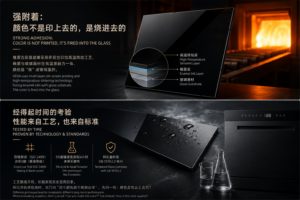
02 | Strong Adhesion: The Color Isn’t Printed On—It’s Fired In
With a lot of the glass panels on the market, the color is simply printed on the surface.
SuperVIG takes a different path: multi-layer silk-screen printing plus high-temperature firing fuses the enamel ink and the glass substrate into one at high heat—the color is “fired” into the glass.
What’s the difference? Surface printing fears scratches, sunlight, and time. A fired glaze layer and the glass are one and the same—achieving Class 0, the highest rating, on the cross-cut adhesion test (ISO 2409).
So when you’re evaluating suppliers, don’t just ask “Can you make this color?” First ask: *How is the color applied?* Different process routes mean completely different long-term performance.
03 | Easy Clean: A Panel You Wipe Every Day—How Quickly It Wipes Clean Is Part of the Experience

Grease, water spots, fingerprints—these are the unavoidable daily reality of appliance panels.
SuperVIG’s glaze surface is dense and smooth, paired with a hydrophobic and oleophobic treatment, so grease won’t stick—one wipe and it’s clean. According to the manufacturer’s side-by-side testing, cleaning efficiency improves by about 50%. Combined with anti-fingerprint and anti-glare surface treatments, the panel stays easy on the eyes under bright light and leaves no marks to the touch.
For users, that means fewer wipe-downs every day. For brands, it’s a real differentiator you can actually talk about in a market where appliance exteriors have become lookalikes.
04 | Flexible Customization: What Buyers Need Isn’t Just a Piece of Glass—It’s a Production Line That Can Keep Up

During new product development, designs keep changing: one day the texture gets adjusted, the next day the color code won’t match in sampling.
SuperVIG supports Pantone color matching, and complex patterns are built up through multiple layers of enamel ink—gradients, marble veining, brushed metal, all with smooth transitions. What matters even more: sampling and mass production run on the same process line. What the sample looks like is exactly what the batch will look like.
A supplier’s color-matching capability is only as reliable as its batch-to-batch consistency in mass production—and we recommend writing this directly into your acceptance criteria.
Screening Suppliers? Put These Questions to Them Directly
- What’s the glaze hardness? Can you provide acid/alkali resistance test reports?
- Is the color printed or fired? What’s the cross-cut test rating?
- What kind of easy-clean treatment is used? How was the data measured?
- Can you match Pantone colors? How do you control color difference across mass production batches?
A good-looking sample doesn’t count—clear answers do.
SuperVIG: From Sample Approval to Production Support
Choosing a glass panel supplier is, in essence, choosing a long-term link in your supply chain. Passing the sample stage is only step one. Beyond that, you need performance backed by test reports, stable color consistency in mass production, and a seamless transition from sampling to volume manufacturing.
SuperVIG appliance glass panels cover refrigerators, wine coolers, ovens, gas stoves, range hoods, dishwashers, washing machines, water heaters, and more—from the kitchen to the living room, from home appliances to commercial spaces.
Beautiful at first sight. Durable every day.
If you’re developing a new product or evaluating suppliers, feel free to send us your product drawings, renderings, or Pantone color codes directly. To confirm the actual finish for yourself, leave a message or add our business WeChat to request samples along with the corresponding test reports.