
Low-E, Solar-Control Coatings, Triple Glazing—What No One Tells You About Choosing the Right Insulated Glass | SuperVIG
There’s a saying that gets repeated in renovation groups:
“Don’t use single-pane glass. Switching to insulated glass will make a big difference.”
Many homeowners believed it, made the switch, and then found that the living room was still hot the very first summer.
Then they started wondering: Did I buy a fake product? Was there a problem with the installation?
Neither. The reason is that insulated glass isn’t just one type of glass—it’s a whole family, and the performance differences between its members can be substantial.
There are three main members of the insulated glass family
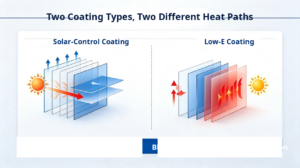
Member 1: Solar-Control Coated Glass
The basic idea is to apply a thin metal or metal-oxide coating to the glass surface, reducing the amount of solar radiation entering the room through reflection and absorption.
Advantage: A low solar heat gain coefficient (SHGC) provides clear benefits for summer heat control.
Limitations:
- Visible light transmittance also decreases, reducing indoor daylight.
- After the coating absorbs solar energy, its temperature rises, creating secondary heat transfer—some of that absorbed heat still makes its way indoors.
- Best suited to applications where daylighting is not the top priority and solar control is the main concern.
Member 2: Low-E Glass (Low-Emissivity Coated Glass)
The core principle of Low-E glass is not to “reflect sunlight,” but to reduce the emissivity of the glass surface, making it harder for long-wave thermal radiation to exchange heat across the glass.
This distinction is important:
- Solar-control coatings primarily address short-wave solar radiation.
- Low-E coatings primarily address long-wave thermal radiation.
Low-E glass also comes in two main types:
- High-transmittance Low-E: High visible light transmittance and good daylighting, suitable for northern climates where solar heat gain is beneficial in winter.
- Solar-control Low-E: Adds solar-control performance to low emissivity, making it suitable for hot-summer climates.
Member 3: Insulated Glass (Gas-Filled)
Insulated glass uses a sealed gas-filled space to reduce conductive and convective heat transfer.
Key parameters:
- Air-space thickness: Typically 12 mm or 16 mm. If the space is too thin, insulation is limited; if it is too thick, gas convection can increase.
- Filling gas: Regular air vs. argon—argon has lower thermal conductivity and provides better insulation, but it requires good sealing workmanship.
- Spacer: Standard aluminum spacers conduct heat quickly and create an edge thermal bridge; warm-edge spacers, such as stainless steel or composite materials, can significantly reduce edge heat loss.
Triple Glazing: More Layers, but Not a Universal Solution
Triple glazing (three panes of glass and two gas-filled spaces) can further reduce U-value and offers clear advantages in cold climates.
But it also has limitations:
- Greater weight, placing higher demands on the window frame and hardware.
- More pronounced frame thermal-bridge effects—the frame accounts for a larger share of the assembly, so if the spacers and frame are not properly designed, the whole-window U-value can rise significantly.
- Significantly higher cost.
Triple glazing is not simply “better insulated glass.” It is a targeted solution for specific applications, primarily cold and very cold climates.
Understanding Insulated Glass Performance: Three Levels
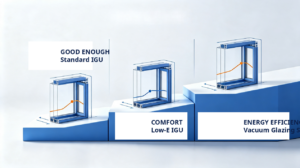
For residential exterior windows:
GOOD ENOUGH
Standard insulated glass, without a coating, has a whole-window U-value of about 2.8–3.2 W/(m²·K).
It is better than single-pane glass, but both summer and winter still require the HVAC system to “pick up the slack.”
COMFORT
Low-E insulated glass, combined with an appropriately designed gas space and warm-edge spacers, can bring the whole-window U-value below 2.0.
Indoor temperature comfort improves noticeably, and the HVAC load is reduced.
ENERGY EFFICIENCY
Building on this, the SuperVIG vacuum glazing system can further reduce the whole-window U-value.
Windows and doors go from being a “passive problem to fix” to an active building component that helps reduce energy use.
Choosing Insulated Glass? Remember This Core Principle
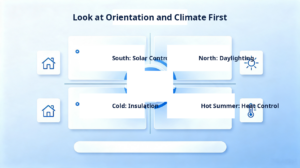
The goal is not simply to block as much sunlight as possible. It is to find the optimal balance between U-value and g-value while maintaining adequate daylight.
Specifically:
- South-facing windows with strong summer sun: Prioritize solar-control Low-E, control the g-value, and still maintain adequate daylight.
- North-facing windows where daylight is the priority: Choose high-transmittance Low-E, prioritize U-value, and allow a relatively more flexible g-value.
- Cold climates where winter insulation is the priority: Prioritize U-value and consider triple glazing with warm-edge spacers.
- Hot-summer, mild-winter climates where summer heat control is the priority: Prioritize g-value and also consider the light-to-solar-gain ratio (LSG).
One Often-Overlooked Detail: Warm-Edge Spacers
When choosing insulated glass, many people look only at the glass performance data and overlook the spacer.
But the spacer is one of the main sources of edge thermal bridging in insulated glass.
Standard aluminum spacers have a thermal conductivity of about 160 W/(m·K). Heat travels rapidly along the aluminum spacer, creating a noticeable cold zone around the edge of the glass. That is why some windows show no condensation in the center of the glass, while water droplets keep appearing around the perimeter.
Switching to warm-edge spacers, such as stainless steel or composite materials, can reduce edge thermal bridging by 30%–60%, significantly improving whole-window U-value and condensation performance.
SuperVIG has also optimized this area through dedicated edge-sealing design for its vacuum glazing systems.
If you have a window and door configuration sheet or are wondering whether your insulated glass is “good enough,” send us the window type, area, and orientation. SuperVIG can provide a simple “Is Your IGU Good Enough?” diagnostic—so your choice is backed by data, not guesswork.
In the next article, we’ll take the next critical step: why vacuum glazing can push thermal insulation to the “limit,” and the fundamental difference between vacuum glazing and insulated glass.