It’s Not About the Number of Layers. It’s About the Heat-Transfer Paths—SuperVIG Explains the Fundamental Difference
In the previous article, we explained how vacuum glazing works.
This time, we’re putting vacuum glazing and insulated glass side by side for a true comparison—not just comparing spec sheets, but looking at how their differences actually show up in real-world use.
Difference #1: The Number of Heat-Transfer Paths
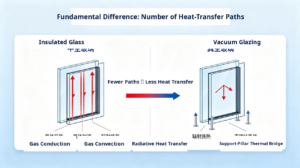
This is the most fundamental difference.
In an insulated-glass cavity, heat can travel through three paths at the same time: gas conduction, gas convection, and radiative heat transfer.
In a vacuum-glazing cavity, the first two paths are almost completely eliminated, leaving only radiative heat transfer and thermal bridging through the support pillars.
Fewer paths mean less total heat transfer, so the U-value is naturally lower.
It’s not because the material is better or the manufacturing process is more sophisticated—it’s because the number of heat-transfer pathways is fundamentally reduced.
Difference #2: Performance Stability
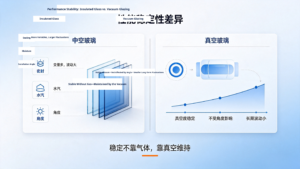
The performance of insulated glass is affected by multiple variables:
- Seal quality: Aging seals or improper installation can allow gas to escape, reducing performance.
- Desiccant condition: When the desiccant becomes ineffective, moisture can enter the cavity and cause the glass to fog.
- Installation angle: Gas convection inside the cavity differs between vertical and sloped installation, so performance can vary.
- Service life: Over time, both the seals and the condition of the gas can change.
Vacuum-glazing performance depends primarily on whether the vacuum level remains stable. Once a stable vacuum is established:
- Performance is not affected by installation angle (no gas means no difference in convection).
- Performance is not affected by gas leakage (there is no gas to begin with).
- Long-term performance fluctuations are smaller.
For buildings intended to operate for many years, this difference is important. You don’t want a window to perform dramatically worse in Year 5 than it did in Year 1.
SuperVIG makes long-term vacuum stability one of its core R&D priorities, with the goal of maintaining stable thermal performance throughout the product’s design life.
Difference #3: Dependence on Low-E Coatings
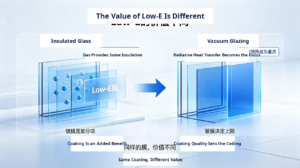
In insulated glass, the gas-filled cavity provides part of the insulation, so the Low-E coating is an added benefit.
In vacuum glazing, the role of gas is nearly zero, making the Low-E coating the primary means of controlling radiative heat transfer. Its importance increases significantly.
This means:
- Vacuum glazing places higher demands on coating quality.
- A high-quality coating can deliver greater value in vacuum glazing.
- The combination and matching of the coating and vacuum cavity directly determine the final performance.
SuperVIG has carried out extensive fine-tuning of this combination, which is also one of the major sources of performance differences among vacuum-glazing products.
Difference #4: Different Whole-Window System Design Requirements
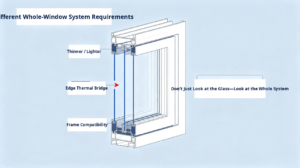
Because vacuum glazing is thinner and lighter, its requirements for the window-frame system differ from those of insulated glass.
At the same time, the edge-sealing structure of vacuum glazing must be properly matched to the frame system to prevent edge thermal bridging from offsetting the performance advantages of the vacuum cavity.
That’s why SuperVIG does not simply provide a piece of glass. We provide a whole-window system solution that includes recommendations for frame-material compatibility.
Where Each One Fits
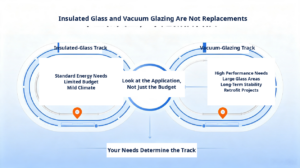
Insulated glass is better suited to:
- Standard energy-efficiency needs where an extremely low U-value is not required.
- More limited budgets, where the goal is to achieve the best possible performance above the “comfort line.”
- Relatively mild climates and applications where the glass area is not especially large.
SuperVIG vacuum glazing is better suited to:
- Applications with higher U-value requirements, where the goal is to reach the “energy-efficiency” range.
- Large areas of glass where windows and doors account for a significant share of overall heat loss.
- Passive House, near-zero-energy, and other buildings with clearly defined thermal-performance requirements.
- Applications where long-term stability matters and significant performance degradation over time is not acceptable.
- Retrofit projects where existing frame dimensions are limited and a thinner glazing solution is needed.
The Bottom Line
Insulated glass and vacuum glazing are not simply old and new versions of the same solution—they are two different tracks. Which one you choose depends on your application, not simply on your budget.
Send us your basic project information, and SuperVIG can help determine whether your needs are still on the insulated-glass track—or whether you’ve entered the vacuum-glazing track.