

Insulating glass made from two panes of glass may look much the same on the outside — yet some units are labeled “argon-filled,” and others are not.
What difference does that extra gas-filling step actually make?
For customers who care about building insulation, window energy efficiency and living comfort, it’s worth first understanding that invisible layer of gas inside the cavity.
01 Why fill insulating glass with argon?
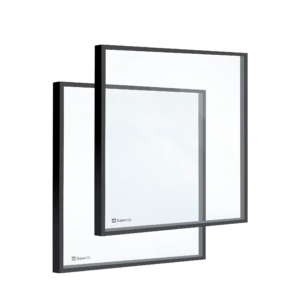
SuperVIG® insulating glass uses spacer bars to separate the panes and form a sealed cavity. Standard products are usually filled with dry air, while argon-filled insulating glass replaces most of the air in the cavity with argon.
Argon is colorless, odorless and chemically stable. Under similar temperature conditions, the thermal conductivity of the two gases is:
Air: approx. 0.0257 W/(m·K)
Argon: approx. 0.0176 W/(m·K)
Argon’s thermal conductivity is about 31% lower than air’s.
This means that, when conditions such as cavity width and gas concentration are appropriate, argon helps reduce heat transfer across the gas layer, thereby improving the thermal insulation performance of the insulating glass.
But note that a 31% lower gas thermal conductivity does not mean a 31% improvement in overall window energy efficiency. Actual performance also depends on the glass structure, Low-E coating and window frame configuration.
02 What’s the difference between argon-filled and non-argon-filled glass?
| Item | Without argon | With argon |
| Cavity gas | Dry gas | Argon (inert gas) |
| Gas thermal conductivity | approx. 0.0257 | pure argon approx. 0.0176 |
| Relative thermal conductivity | Baseline | about 31% lower |
| Whole-window K-value | Baseline | approx. 0.15–0.3 W/(m²·K) lower |
| Thermal insulation performance | Basic insulation | Can improve by approx. 15%–30% with proper configuration |
| Condensation risk | Affected by environment and structure | Helps reduce it |
| Cost | Relatively low | Adds the cost of the gas-filling process |
Note: The unit of thermal conductivity is W/(m·K). The above compares gas physical properties and general performance trends; actual product performance is subject to the corresponding configuration and test results.
To assess the insulation capability of insulating glass, the glass heat transfer coefficient (Ug) is usually the metric to watch.
The lower the Ug value, the better the insulation performance of the glass portion.
Argon filling helps lower the glass Ug value, but the degree of improvement depends on the cavity width, coating and gas concentration; a single figure cannot be applied directly to every product.
03 What practical value does argon filling bring?
Reduces winter heat loss and improves comfort near windows

During winter heating, heat flows outward through the windows. Appropriate argon filling helps reduce heat loss through the glass and improves thermal comfort in the area near the windows.
For buildings such as residences, offices and hotels, this improvement supports indoor insulation and heating energy control.
Reduces summer differential-temperature heat transfer and helps control air-conditioning energy use

In summer, when outdoor temperatures are high, the argon layer reduces heat transfer caused by temperature differences.
Combined with a suitable Low-E coating, it can further control radiant heat transfer.
The two technologies work in different ways; a sensible combination helps optimize the overall thermal performance of energy-efficient windows and doors.
Improves glass surface temperature and lowers condensation risk
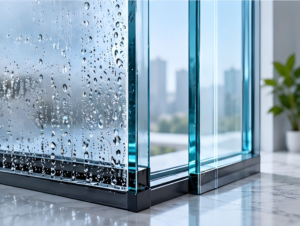
In winter, some windows tend to develop water droplets, which relates to the glass surface temperature and indoor air humidity.
When the glass surface temperature drops below the air dew point, condensation can occur.
Argon filling helps improve the insulation performance of insulating glass, raising the indoor-side glass surface temperature under certain conditions and thereby lowering condensation risk.
However, indoor humidity, the spacer bars and thermal bridging at the frame also affect the outcome, so filling with gas does not completely eliminate condensation.
04 What’s the difference between argon-filled and non-argon-filled glass?

More argon is not always better, and filling alone does not guarantee the expected result.
First, check the gas concentration.
Argon filling does not mean the cavity contains 100% argon; the actual fill concentration affects insulation performance, so you should look at the product configuration and test data.
Second, check the sealing quality.
Argon is chemically stable, but if the edge seal of the glass is not good enough, it can still gradually leak out over time. That’s why the sealing structure and gas-retention capability matter just as much.
Finally, consider the overall configuration.
The Low-E coating, cavity width, glass thickness and gas fill need to be matched properly. For engineering projects, rather than focusing only on the cost of gas filling, you should evaluate comprehensively against heat transfer coefficients and building energy-efficiency requirements.
SuperVIG®: Matching Glass Configurations to Building Energy-Efficiency Needs
As building energy-efficiency requirements continue to rise, choosing insulating glass is no longer just about thickness and price — it also needs to balance insulation performance, comfort and long-term stability.
SuperVIG® insulating glass is designed for applications such as building windows, doors and curtain walls. It evaluates technical solutions — including gas filling, glass structure and coating configurations — against each project’s insulation and thermal performance requirements.
From standard air filling to argon filling, it may seem like simply a change of the gas inside the cavity, but behind it lies an approach to optimizing the thermal performance of the glass.
The value of SuperVIG® insulating glass lies not in how many technologies it adds, but in matching insulation performance to actual usage needs through sensible configuration.