
| Let’s start with a question that often comes up on project sites. Why can a window or door still feel cold indoors in winter and allow significant heat gain in summer even when thermal-break profiles are used? Why can profile specifications look good at the design stage, yet the completed window system fail to achieve the expected thermal performance? The problem is often not just the glass—and it is not simply that the profile’s thermal conductivity is too high. |
For architects, window and door manufacturers, and engineering professionals, the key question is: what is the relationship among profile material, cross-sectional design, and heat transfer through the complete window system?
一、1. WHY YOU CAN’T EVALUATE THERMAL-BREAK WINDOWS AND DOORS BY PROFILE THERMAL CONDUCTIVITY ALONE
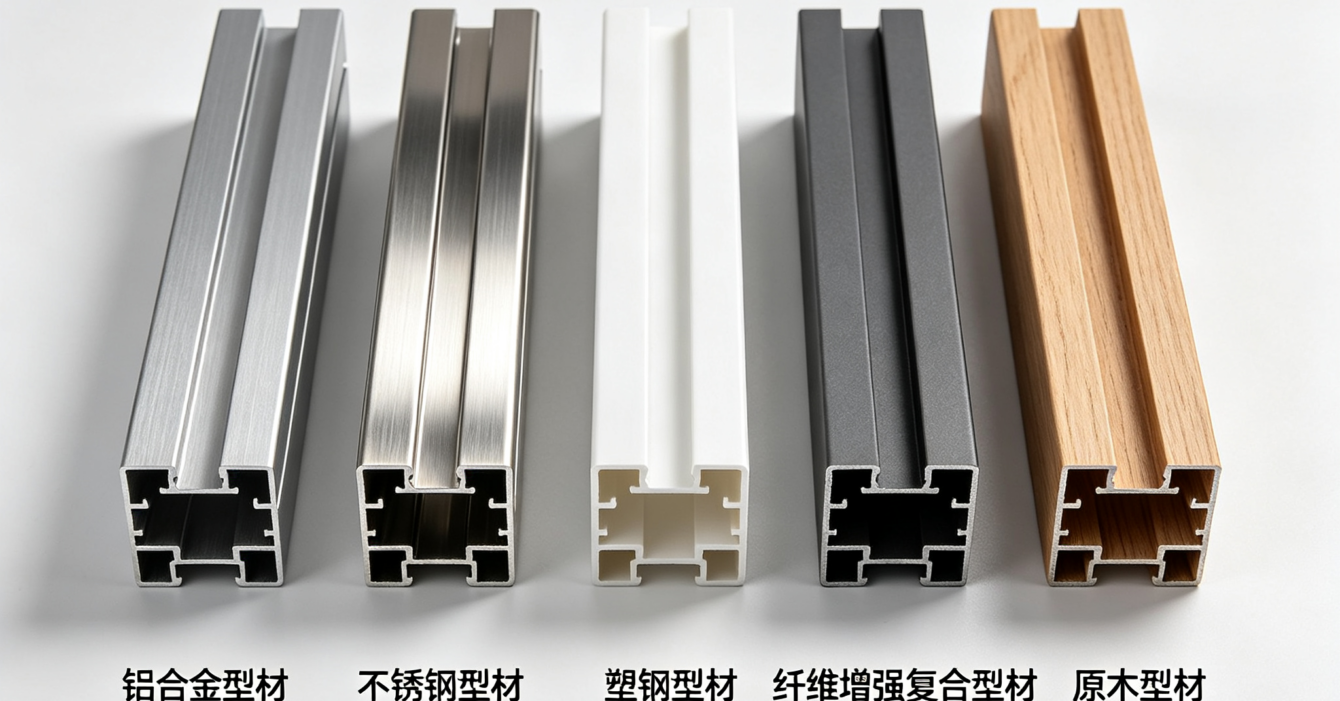
Common frame materials include aluminum alloy, stainless steel, uPVC, fiber-reinforced composite profiles, and natural wood.
Aluminum alloy has a thermal conductivity of approximately 160 W/(m·K), while stainless steel is approximately17 W/(m·K). uPVC, fiber-reinforced profiles, and natural wood have significantly lower values.
| KEY TAKEAWAY Low-thermal-conductivity profiles can help reduce heat transfer through the frame, but material thermal conductivity is only the starting point for selection—it does not equal whole-window performance. |
二、2. WHY IS ALUMINUM ALLOY STILL AN IMPORTANT CHOICE FOR ARCHITECTURAL WINDOWS AND DOORS DESPITE ITS HIGH THERMAL CONDUCTIVITY?
Aluminum alloy itself has relatively high thermal conductivity, but it offers mature mechanical performance, manufacturing processes, cross-sectional design options, and hardware compatibility. It is well suited to large windows and doors, large expanses of glazing, and high-rise buildings.
Therefore, the thermal-break strategy for aluminum windows and doors is not to make aluminum itself a low-conductivity material, but to reduce continuous heat flow through the aluminum using thermal breaks, multi-chamber designs, and insulating strips.
Aluminum alloy provides high strength and mature fabrication capabilities. Multi-chamber designs can readily achieve air tightness, water tightness, and wind-load resistance. However, because the base material has relatively high thermal conductivity, thermal-break structures are needed for insulation.
3. AN OFTEN-OVERLOOKED FACT: THE FRAME MAY OCCUPY A SMALL AREA BUT CONTRIBUTE SIGNIFICANTLY TO HEAT TRANSFER
Many people assume that because glass accounts for a large portion of the total window area, energy efficiency is mainly determined by the glass. However, one set of calculated results deserves attention from engineering professionals.
| Profile | Overall Heat Transfer Coefficient | Frame Heat-Transfer Contribution |
| Aluminum Profile (Non-Thermal-Break) | 2.62 | 39.1% |
| Stainless Steel | 2.56 | 38.6% |
| uPVC | 1.84 | 25.8% |
| Fiber-Reinforced Profile | 1.91 | 28.0% |
| Natural Wood | 1.78 | 23.9% |
| 17.9% → 39.1% Under these calculation conditions, the frame area accounts for only 17.9% of the total window area, yet the non-thermal-break aluminum profile accounts for 39.1% of heat transfer through the frame. A smaller area does not necessarily mean a smaller impact on heat transfer. |
This is why high-performance window and door design must also consider the frame, the glazing edge, and thermal bridges at connections and details.
4. DOES A LOW-THERMAL-CONDUCTIVITY PROFILE AUTOMATICALLY MAKE IT BETTER FOR EVERY PROJECT?
| Material | Advantages | Engineering Considerations |
| uPVC | Low thermal conductivity, lightweight, good sound insulation | Thermal deformation, UV aging, and thermal bridges from steel reinforcement |
| Fiber-Reinforced Profile | Low thermal conductivity, coefficient of linear expansion close to that of glass, salt-spray resistance | Mechanical anisotropy and optimization for large-size structures |
| Natural Wood | Natural material, relatively low thermal conductivity, attractive appearance and feel | Weather resistance, maintenance, cracking, and deformation |
uPVC has a relatively large coefficient of linear expansion and may experience thermal deformation under prolonged sun exposure. Fiber-reinforced profiles require attention to mechanical anisotropy. Natural wood requires careful consideration of sun and rain exposure, moisture-related swelling and shrinkage, cracking, deformation, mold, and long-term maintenance.
| ENGINEERING SELECTION REMINDER Don’t ask, “Which material has the lowest thermal conductivity?” Instead, ask: Does this material and structure match the project’s size, environment, weather-resistance requirements, structural requirements, and energy-efficiency goals? |
5. FIVE KEY FACTORS TO CONSIDER WHEN SELECTING WINDOW & DOOR PROFILES
| Factor | Why It Matters |
| ① Thermal Performance | Establishes the material’s fundamental heat-transfer characteristics |
| ② Cross-Sectional Design | Profiles made from the same material can perform differently depending on chamber configuration and thermal-break design |
| ③ Frame Heat-Transfer Contribution | Shows the profile’s actual impact on whole-window thermal performance |
| ④ Thermal-Deformation Compatibility | Considers differences in deformation between the frame and glass, as well as condensation risk |
| ⑤ Project Environment | High-rise, coastal, large-size, extremely cold, and high-humidity environments have different requirements |
| PART 1 CONCLUSION Selecting thermal-break windows and doors is not about finding the “most insulating” material; it is about finding the material and structure that best match the building’s performance goals. |
In the next part, we will address another key question: once the profile has been optimized for thermal insulation, why does the glass become the next component to focus on? And how should the profile and glass be combined to move from “material selection” to “whole-window system design”?