Energy-efficiency rules keep climbing, so window thermal design is now a big deal in drawing review and detailed design. Memorize the specs without understanding the physics, and you can easily end up with a system that “passes on paper” but disappoints in real life.
This series breaks the tech down without the fluff. Part 2 goes into what really changes insulating-glass performance. It’s based on JGJ/T151, GB/T2680, ISO15099 and spectral testing, so save this one if you’re doing selection or design.
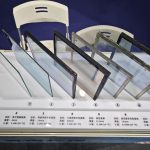
I. The Glass Types Inside an Insulating-Glass System
1. Solar Control Coated Glass
(solar control coated glass)
A coating changes the glass optics so it selectively reflects and absorbs sunlight from 300nm~2500nm. There are offline and online solar control coatings.
How it works:
It cuts solar heat mainly by reflecting more sunlight. The catch: the coating can also absorb a lot of solar energy, heating the glass up. Because the coating surface has high emissivity, some of that absorbed heat then radiates indoors as secondary heat transfer. So direct transmission can look low while total solar heat gain is still fairly high.
⚠️ The catch:
Surface reflectance is capped at 30% to control light pollution, and the coating’s high E value means it reflects very little infrared. So overall thermal insulation is only average.
What to watch: g value and SC value.
📊 Typical numbers for monolithic coated glass:
| U值 U value | SC | g(SHGC) | 可见光Tv Visible Light Tv | 可见光Rf Visible Light Rf | 可见光Rb Visible Light Rb | 太阳能Ts Solar Ts | 太阳能Rf Solar Rf | 太阳能Rb Solar Rb | Abs1 |
| 4.92 | 0.50 | 0.43 | 0.32 | 0.17 | 0.21 | 0.30 | 0.14 | 0.24 | 0.56 |
💡 Basically:
Solar control glass can bounce back some sunlight, but the coating also soaks up heat, gets hot, and sends some of that heat indoors. Add the reflectance limit and high E value, and its infrared blocking is pretty weak. Overall insulation: decent, not amazing.
2. Low-Emissivity Coated Glass
(low emissivity coated glass)
This coating changes surface emissivity and optical performance, giving high reflectance to infrared in the 4500~25000nm range. Aka Low-E glass.
Types:
By process, Low-E comes in offline and online versions. Offline Low-E then breaks down into single-silver, double-silver, and triple-silver.
How it works:
The low-emissivity coating drops the glass surface emissivity, so it reflects infrared hard and slows infrared heat getting indoors. Adjusting coating thickness also lets you tune solar transmission and absorption.
What to watch:
- E value (emissivity): offline Low-E ≤0.15; online Low-E ≤0.25
- SC value (g value)
📊 Typical numbers for monolithic double-silver Low-E glass:
| U值 U value | SC | g(SHGC) | 可见光Tv Visible Light Tv | 可见光Rf Visible Light Rf | 可见光Rb Visible Light Rb | 太阳能Ts Solar Ts | 太阳能Rf Solar Rf | 太阳能Rb Solar Rb | Abs1 |
| 3.09 | 0.475 | 0.413 | 0.68 | 0.10 | 0.06 | 0.38 | 0.35 | 0.37 | 0.26 |
💡 Basically:
Low-E is all about low emissivity: reflect infrared, keep more heat outside, and still tune how much sunlight gets through or gets absorbed. More silver layers – like triple-silver – usually means stronger reflection and better spectral control.
II. What Makes Up an Insulating-Glass System
Insulating glass system:
Two or more panes of glass [or other transparent materials] are evenly spaced, supported, and sealed around the edge to create a dry gas cavity between them.
Main parts:
- Glass: float glass, coated glass, tempered glass, laminated glass, fire-resistant glass, vacuum glass, patterned glass, etc. The panes can be the same type or mixed.
- Spacer:
- Rigid spacer: aluminum, stainless steel, polypropylene + stainless steel, glass-fiber-reinforced composite + composite film, etc.
- Flexible spacer: composite sealing strips, thermoset microporous elastic spacers, plus reactive or non-reactive thermoplastic spacer sealants.
- Desiccant
- Gas layer: air, argon, or other inert gases
- Secondary sealant: structural silicone, structural polyurethane, etc.
💡 Basically:
Insulating glass is a full system – glass, spacers, desiccant, gas layer, sealant. Change any one of those materials and you change the final thermal performance of the dry gas cavity.
III. How Heat Moves Through Insulating Glass
- Spectral optics: transmission, reflection, absorption, shading, visible light, total solar transmittance.
Model boundary: assume solar radiation only; indoor and outdoor reflectance are set to 0. - Thermal heat transfer: gas-layer convection, radiation, inclination angle, overall thermal transmittance.
Boundary condition: no solar radiation in the thermal calculation.
💡 Basically:
You need to check insulating glass in two modes: with sunlight, look at what gets through, reflected, and absorbed; without sunlight, look at convection and radiation inside the gas gap.
IV. How Glass Properties Change the System’s Optical Performance
Spectral transmittance calculation (iterative for multi-pane glass)
τtotal(λ), ρtotal(λ), αtotal(λ) = spectral transmittance, reflectance, and absorptance; together they equal 1.
τ1(λ), τ2(λ) = spectral transmittance of the front and rear panes.
ρ12(λ), ρ21(λ) = cavity-side spectral reflectance of the front and rear panes.
Total solar heat gain coefficient g(SHGC) = direct solar spectral transmittance + secondary heat transfer from heat absorbed by the glass and sent indoors.
Using the standard Chinese indoor/outdoor surface heat-transfer coefficients, the equation can be written as a function of fixed coefficients, transmittance, and absorptance. Put that into the SC formula and you get:
💡 What actually drives the result:
- g value goes up with the direct solar transmittance of the two or more panes in the insulating-glass system.
- Once transmittance is fixed, g also depends on the reflectance of the four glass surfaces – because reflectance then determines absorptance.
- Big takeaway: based on the SC formula, SC is independent of surface emissivity. So solar control coated glass can hit the same SC as Low-E glass.
💡 Basically:
Same SC does not mean same insulation. Solar control glass and Low-E can land on the same SC number, but they get there in totally different ways because SC itself doesn’t care about surface emissivity.
V. How Glass Properties Change Thermal Performance
With no sunlight in the equation, insulating-glass thermal performance comes down to three things: solid heat transfer, convection through the gas gap, and radiation across the gas gap.
- Solid Heat Transfer
Glass thermal conductivity is generally taken as 1W/m·K. Once the number of gas layers is fixed, glass thickness is the main factor controlling solid heat transfer. - Convective Heat-Transfer Coefficient hc0 of the Gas Gap
When the glass is installed vertically, the inclination angle is 0°:
- d: gas-gap thickness
- λ: thermal conductivity of the gas in the gap, W/m·K
- Nu: Nusselt number; it depends on Rayleigh number Ra, gas-gap aspect ratio, and inclination angle θ.
Rayleigh number = Grashof number × Prandtl number:
- Gr (Grashof number): natural convection in the gas gap is driven by buoyancy from temperature differences. Characteristic length depends on gap thickness d; g = 9.81m/s²; β=1/Tm; ΔT = surface-temperature difference between the two panes; ν = gas kinematic viscosity.
- Pr (Prandtl number): a dimensionless number linking momentum transfer and thermal-energy transfer in the fluid. Typical values: dry air 0.703, argon Ar0.680, krypton Kr0.67.
Effect of installation angle:
Tilt the glass away from vertical and the buoyancy component along the heat-transfer surface drops, while the normal component suppresses convection vortices. Result: more tilt = weaker convection.
Equivalent Rayleigh number: Raθ = Ra0cosθ
According to ISO15099 and GB/T2680, once the installation angle is above 60° and up to 90°, the tangential gravity component drops hard and convection vortices are suppressed. Correction for insulating-glass systems only: Nuθ = 1 + (Nu0 – 1)cos2θ
- Interlayer Radiative Heat-Transfer Coefficient hr
- σ: Stefan-Boltzmann constant = 5.67×10⁻⁸ W/(㎡·K⁴)
- ε1, ε2: emissivity of the two glass surfaces facing the insulating cavity
- Tm: average glass-surface temperature
- Thermal Resistance of the Insulating-Glass System
Series-add the resistances: R1# glass + R gas heat transfer + R radiative heat transfer + R2# glass = R total(m2·K/W)
And that ultimately gives the insulating-glass K(U) value.
💡 Basically:
With no sunlight, insulation depends on glass thickness, gas movement in the cavity, and the emissivity of the two glass surfaces. More tilt suppresses convection; a low-emissivity coating cuts radiative heat transfer. Both help bring K(U) down.
*Reference standards: JGJ/T151, GB/T2680, ISO15099, etc.*
【Next Up】
Theory done. Next article: real engineering numbers, head-to-head solar control vs. Low-E results, and the best picks for different orientations and configurations.