Once You Understand How Vacuum Glazing Works, You’ll See the Difference Between It and Insulated Glass | SuperVIG
Here’s a question that confuses a lot of people:
Vacuum glazing and insulated glass both look like two panes of glass with a cavity between them.
So why can vacuum glazing deliver thermal insulation that is an order of magnitude better than insulated glass?
The answer is not that the “material is better,” but how many heat-transfer paths have been eliminated.
Heat Travels Through Glass in Three Ways
To understand why vacuum glazing performs better, first you need to understand how heat moves through a glass cavity.
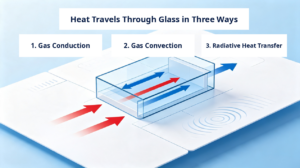
Path 1: Gas Conduction
Heat is transferred directly between gas molecules. The lower the thermal conductivity of the gas, the harder it is for heat to travel this way.
Path 2: Gas Convection
As gas is heated, its density changes, causing it to circulate and carry heat from one side to the other. This is the most difficult heat-transfer mechanism to control in insulated glass.
Path 3: Radiative Heat Transfer
Glass surfaces exchange energy through thermal radiation. The lower the emissivity, the harder it is for heat to transfer this way—which is also the primary role of a Low-E coating.
- Insulated Glass: All Three Paths Remain—They’re Just Minimized
- The strategy of insulated glass is to minimize heat transfer within the gas-filled cavity.
- Use a better gas (argon has about 34% lower thermal conductivity than air)
• Adjust the cavity thickness (to reduce convection)
• Add a Low-E coating (to reduce radiative heat transfer)
But no matter how much you optimize the design, the gas is still there. And as long as gas is present, convection cannot be completely eliminated. This is the performance ceiling of insulated glass.
Vacuum Glazing: Eliminate the First Two Paths
The strategy of vacuum glazing is more direct:
Reduce the gas pressure inside the cavity to a near-vacuum state (about 0.1 Pa, roughly one-millionth of atmospheric pressure), making gas conduction and gas convection almost impossible.
As a result:
• Gas conduction: nearly zero
• Gas convection: nearly zero
• What remains is radiative heat transfer and thermal bridging through the support structure
This is the fundamental reason vacuum glazing can achieve extremely low U-values—not because the material is better, but because two major heat-transfer paths have been directly eliminated.
- The Key Structure of Vacuum Glazing: Support Pillars
- Here’s a detail many people don’t know.
Atmospheric pressure pushes inward on the two panes of vacuum glazing (about 10 tons per square meter). To prevent the glass from collapsing, tiny support pillars are placed between the two panes.
The material, size, and spacing of these support pillars directly affect two things:
• Thermal bridging: Support pillars are solid and conduct heat, making them one of the primary sources of thermal bridging in vacuum glazing.
• Visual appearance: Pillars that are too large or improperly spaced can affect transparency and aesthetics.
SuperVIG has invested heavily in optimizing support-pillar design, with the goal of minimizing their thermal-bridge effect while maintaining structural strength and visual quality.
Why Can Vacuum Glazing Make Better Use of Low-E Coatings?
In insulated glass, the gas-filled cavity itself provides part of the thermal insulation, so the Low-E coating works in an environment where “gas interference” is present.
- In vacuum glazing, the role of gas is nearly zero, making radiative heat transfer the dominant heat-transfer mechanism. At this point, every bit of Low-E performance can translate directly into insulation performance, without the “dilution” effect of gas.
- Simply put: the same Low-E coating can deliver greater value in vacuum glazing than in insulated glass.
SuperVIG has carefully engineered the combination of its coatings and vacuum cavity to maximize their synergistic effect.
Three Engineering Advantages of Vacuum Glazing
Beyond thermal performance, vacuum glazing offers three advantages that are especially important in engineering applications:
Advantage 1: Thin and Lightweight
The cavity in vacuum glazing is typically only 0.1–0.3 mm thick, making the overall thickness much smaller than that of insulated glass.
This is especially important for retrofit projects, where existing window-frame dimensions are limited, and for weight-sensitive applications such as high-rise buildings and specialized structures.
Advantage 2: Less Sensitive to Installation Angle
In insulated glass, gas convection inside the cavity changes with the installation angle, so performance can vary.
Because vacuum glazing has virtually no gas convection, its performance is consistent at different angles—horizontal, vertical, or sloped installation does not affect performance.
Advantage 3: Lower Risk of Condensation
The interior glass-surface temperature of vacuum glazing is higher, so under the same indoor/outdoor temperature difference, the condensation threshold is lower.
This is particularly important in high-humidity regions, refrigerated display cases, medical buildings, and similar applications.
Long-Term Stability of Vacuum Glazing: It Depends on Maintaining the Vacuum
In the long run, the performance of vacuum glazing depends on one thing: whether the vacuum can be maintained.
If the edge-sealing process is inadequate, the vacuum level will decline over time, performance will gradually deteriorate, and the product may eventually perform like ordinary glass.
SuperVIG has invested significant R&D resources in edge-sealing technology and long-term vacuum stability. This is also one of the brand’s core competitive strengths—not simply delivering impressive specifications at the factory, but maintaining designed performance 10 or 20 years later.
Vacuum glazing is not something everyone must choose, but it is worth evaluating carefully.
If you are considering your options, send us the existing glass configuration, building location, and application scenario.
SuperVIG will use a thermal-performance model to provide a comparative assessment of insulated glass versus vacuum glazing, so your decision is supported by data.