

Even among insulating glass units, why do some products use polysulfide sealant, others polyurethane sealant, and still others silicone structural sealant?
For building windows, doors and glass curtain walls, glass performance depends not only on thickness, Low-E coatings and insulating-cavity configuration, but is also closely tied to the edge-sealing structure.
If the sealing system fails, moisture can enter the glass cavity and cause internal fogging. Argon-filled insulating glass may also lose gas, which degrades its thermal insulation performance.
The seemingly unremarkable secondary sealant actually determines the long-term performance of insulating glass.
01 Why Do Insulating Glass Units Require Dual-Seal Construction?
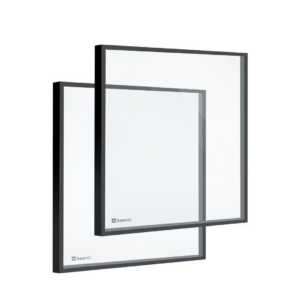
SuperVIG® insulating glass typically adopts a dual-seal structure, with each seal performing distinct functions.
Primary seal: butyl sealant — gas and moisture barrier
Located between the glass panes and the spacer bar, butyl sealant mainly blocks external moisture ingress and prevents the escape of fill gases such as argon from the insulating cavity.
Secondary seal: provides bonding support and enhances edge structural stability
Filled along the glass edges and the outer side of the spacer bar, the secondary sealant helps the glass withstand temperature fluctuations and external service loads during use.
The two seals work together to maintain the sealing integrity of SuperVIG® insulating glass.
SuperVIG® insulating glass adopts dual-seal construction. Its product design prioritizes gas-barrier performance, edge bonding and long-term service reliability.
02 What’s the Difference Between Polysulfide, Polyurethane and Silicone Sealants?
Secondary sealant materials commonly used for insulating glass fall into three main types, each with distinct performance characteristics.
| Comparison Item | Polysulfide Sealant | Polyurethane Sealant | Silicone Sealant |
| Gas (Argon) Permeability | 0.03–0.1 (Low) | Low | ≥20 (Relatively high) |
| Moisture-Vapor Transmission Rate | 5–10 | Lowest | 15–20 (Relatively high) |
| High-/Low-Temperature Resistance / Weatherability | Fair | Fair | Excellent |
| UV-Aging Resistance | Poor; prone to debonding after prolonged sun exposure | Poor | Excellent; no debonding |
| Water Absorption Rate | Relatively high | Relatively low | Low |
| Structural Bonding / Load-Bearing Capacity | Fair | Good | Excellent |
| Typical Applications | Windows & doors, standard framed curtain walls | Windows & doors, standard framed curtain walls | Mandatory for hidden-frame / semi-hidden-frame / point-supported curtain walls |
01 Polysulfide Sealant: Focused on Gas-Barrier Performance
Polysulfide sealant generally offers good gas-barrier capability. It suits building windows, doors and standard framed curtain walls where the glass edges are protected, helping maintain the sealed state of the cavity.
02 Polyurethane Sealant: Balances Barrier and Bonding Requirements
Polyurethane sealant generally provides good gas and moisture-vapor barrier performance and can be used for insulating glass meeting the relevant technical requirements. During application, attention should be paid to its weatherability and material compatibility.
03 Silicone Sealant: Prioritizes Weather Resistance and Structural Bonding
Silicone sealant offers excellent high-/low-temperature resistance, UV-aging resistance and weatherability. Of these, silicone structural sealant meeting structural-bonding requirements is suitable for glass curtain walls with explicit load-bearing and weather-resistance demands.
These three sealant types are not simply ranked as better or worse; each plays its role depending on the service environment.
03 How Do Different Secondary-Seal Materials Affect Insulating-Glass Performance?
- Gas-Retention Capacity — Determines Long-Term Thermal Performance
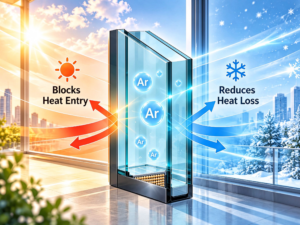
Argon-filled insulating glass leverages argon’s low thermal conductivity to reduce heat transfer.
If the edge-sealing system lacks sufficient gas-retention capacity, argon gradually escapes, which can impair the glass’s original insulation performance.
- Moisture-Vapor-Barrier Capacity — Determines Susceptibility to Internal Fogging
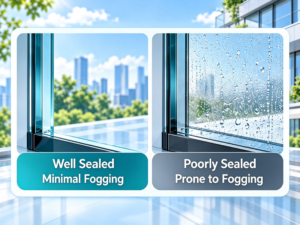
When external moisture keeps entering the cavity, condensation can form inside the glass layers, affecting daylighting and the user experience.
A well-designed dual-seal system helps lower the risk of moisture ingress and reduces replacement and maintenance needs caused by sealing failure.
- Weather Resistance and Bonding Performance — Determines Long-Term Service Reliability
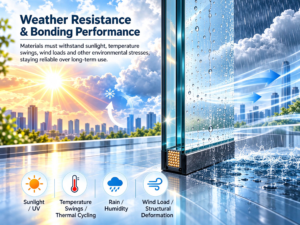
Building windows, doors and curtain walls are constantly exposed to sunlight, temperature swings, wind loads and other environmental stresses.
Choosing a secondary-seal material matched to the working conditions helps reduce the risk of edge-seal failure and minimizes future maintenance issues.
04 Sealing-Material Requirements Vary Across Building Application Scenarios
Edge-sealing requirements differ between regular building windows and doors and glass curtain walls.
Per the Technical Code for Glass Curtain-Wall Engineering (JGJ 102-2003), the secondary seal of insulating glass used in hidden-frame, semi-hidden-frame and point-supported glass curtain walls shall be silicone structural sealant; for framed glass curtain walls, polysulfide insulating-glass sealant is preferred, or a qualified silicone sealant may be used.
Therefore, when assessing whether insulating glass fits a project, do not look only at glass thickness and price — also check whether the sealing system meets the application requirements.
05 SuperVIG®: Attentive to Every Structural Detail of Insulating Glass

The value of an insulating glass unit lies not only in its initial thermal-insulation parameters, but also in long-term sealing reliability.
SuperVIG® insulating glass is designed for building windows, doors and glass curtain walls. With its dual-seal construction, it provides corresponding product options for building energy efficiency, matched to each project’s glass configuration and usage requirements.
From glass material selection and cavity configuration to edge sealing, every structural detail is closely tied to the product’s performance in use.
For customers, choosing insulating glass means considering not only immediate thermal-insulation performance, but also long-term stability and maintenance costs.
Only with sensible material selection and sealing design can insulating glass deliver its full value in real-world building applications.