Introduction
Many people pay attention to glass thickness, layer count and appearance when selecting doors and windows, yet they tend to overlook the internal structure of glass.
For spaces aiming to improve indoor thermal conditions, reduce external noise interference while retaining natural daylighting, vacuum insulating glass is a glass configuration worth knowing about.
Its core concept is not simply to increase the number of glass panes, but to create a vacuum layer between two glass sheets. Together with support structures and sealing structures, it forms a stable product system.
“Vacuum insulating glass is not just about making glass thicker. Instead, it integrates thermal insulation and sound insulation requirements into one product logic through structural design.”
01 Understanding Vacuum Insulating Glass
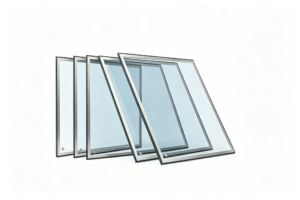
From the perspective of product structure, vacuum insulating glass consists of glass sheets, support pillars, vacuum sealing structures and other components. Some variants can also incorporate functional glass such as Low-E glass.
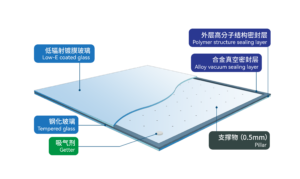
The vacuum layer of the showcased product is 0.5 mm thick. As gas inside the vacuum layer is removed, the product delivers thermal and acoustic performance different from ordinary glass and conventional insulating glass.
Grasping this point means understanding why “vacuum” is critical in product design.
02 Why the Vacuum Layer Matters
Performance Parameter Comparison of Vacuum Insulating Glass
| Product No. | Product Construction | U valueW/m²·K | Visible light Transmittance (TV)% | Indoor Reflectance (Ri)% | Outdoor Reflectance (Ro)% | Solar Total Transmittance (g)% | Shading Coefficient (SC) | Weighted Sound Reduction (dB) |
| VIG01 | XTSLE+0.5V+YTC | <0.8 | 40-75 | <30 | <30 | 0.35 0.5 | 0.4 0.6 | 36 40 |
| VIG02 | XTDLE+0.5V+YTC | <0.6 | 40-75 | <30 | <30 | 0.3 0.5 | 0.4 0.58 | 36 40 |
Explanation of symbols in product construction: X, Y: glass thickness T: tempered SLE: single silver Low E glass DLE: double silver Low E glass 0.5V: vacuum gap C: clear float glass
Thermal insulation is one of the user-perceivable application benefits.
-275x300.png)
Product data shows that vacuum insulating glass can achieve a U-value of less than 0.4 W/(m²·K). According to the parameter table above, VIG01 has a U-value below 0.8 W/(m²·K), while VIG02 features a U-value below 0.6 W/(m²·K). These discrepancies stem from different product specifications and test protocols. Therefore, for project selection, refer to test documentation for the specific model and glass configuration, rather than applying a single set of parameters to all vacuum insulating glass.
Sound insulation is another key application of vacuum insulating glass.
-283x300.png)
VIG01 and VIG02 both deliver a weighted sound reduction of 36-40 dB as shown in the parameter table.
For street-side residences, office premises, hotels and other spaces requiring high indoor quietness, glass selection should not be based merely on pane count. Comprehensive evaluation of glass combinations, window frame systems, installation conditions and site environment is essential.
Besides performance, the sealing structure of vacuum insulating glass also merits attention.
SuperVIG® vacuum insulating glass adopts self-developed alloy materials for vacuum-environment sealing to form a static vacuum system. Its leak-detection rate reaches as low as 5×10⁻¹⁰ Pa·L/s, with a designed service life of over 20 years.
Sustained vacuum integrity is fundamental for long-term retention of performance in doors and windows.
03 Understanding Thermal Insulation, Sound Insulation and Sealing

If you are renovating a residential building or working on door and window design, vacuum insulating glass can be regarded as a performance oriented product enabled by structural engineering.
It does not simply pursue greater thickness. Instead, it achieves thermal and acoustic performance via the combination of vacuum layers, sealing systems, support pillars and functional glass coatings.
SuperVIG® vacuum insulating glass serves as an alternative for comparative evaluation in various projects.
Final selection shall be determined comprehensively according to window dimensions, glass specifications, daylighting requirements, sound insulation targets and building site conditions.
For end users, there is no need to get bogged down in complex material jargon when learning about vacuum insulating glass.
A practical workflow is: first study the structure, then review U value and sound insulation data, examine sealing design and test reports, and finally match the product to real world building scenarios. This approach is more valuable than comparing glass thickness alone.
As a brand specialized in glass products and applications, SuperVIG® VIGECH aims to provide clear product information to help consumers and designers make well informed decisions on door and window glass.