
See How Heat Gets Through Windows and Doors at a Glance — What to Know Before Choosing Insulating Glass | SuperVIG®
Have you ever experienced this?
You set the AC to 26°C, and the living-room thermometer also reads 26°C, but you still feel hot sitting on the sofa by the window.
It’s not that the AC is broken, and it’s not that the thermometer is inaccurate.
The heat has already gotten in—you just can’t see where it came from.
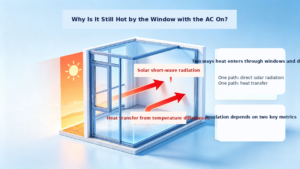
Heat gets through windows and doors in two completely different ways
Many people think insulating windows and doors means just one thing: keep the heat out.
In reality, heat gets through windows and doors in two completely different ways, and each requires a different solution.
Path 1: Solar short-wave radiation
Sunlight isn’t a single type of light. It contains three components:
- Ultraviolet (UV) light (about 5%)
- Visible light (about 43%)
- Near-infrared (NIR) radiation (about 52%)
Near-infrared radiation is a major source of indoor heat. You can’t see it, but it carries substantial energy. It can pass directly through ordinary glass, enter the room, and be absorbed by floors, furniture, and walls, where it is converted into heat and then radiated throughout the space.
That’s why the room can still feel hot after you close the curtains—the heat got in before the curtains were closed.
Path 2: Heat transfer caused by indoor-outdoor temperature differences
Whether it’s day or night, whenever there is a temperature difference between indoors and outdoors, heat slowly “seeps” through the glass and window frame.
In summer, outdoor heat moves inward; in winter, indoor warmth leaks outward.
This path has nothing to do with solar radiation. It continues even on cloudy days and at night.
Two paths, two key metrics
To evaluate the insulating performance of a window or door, you need to look at two metrics at the same time:
U-value (thermal transmittance)
Unit: W/(m²·K)
Measures how quickly heat “seeps” through a window or door. The lower the U-value, the better the window or door resists heat transfer caused by temperature differences.
This metric mainly corresponds to the second path—heat transfer caused by temperature differences.
A standard single-pane window has a whole-window U-value of about 5.0–6.0; standard insulated glass is about 2.8–3.2; SuperVIG® vacuum glass systems can achieve even lower values.
SC/g-value (shading coefficient / total solar energy transmittance)
The lower the SC or g-value, the less solar radiation enters the room, making it less likely for the interior to heat up in summer.
This metric mainly corresponds to the first path—solar short-wave radiation.
These two metrics cover different things: one addresses “seepage,” while the other addresses direct solar exposure. You need both.
Looking only at U-value may lead you to a window that keeps heat in reasonably well during winter but heats up quickly in summer.
Looking only at SC/g-value may lead you to a window with strong solar control but an interior that feels as dark as a basement.
There’s another metric many people haven’t heard of: LSG
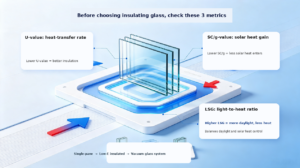
Light-to-solar-gain ratio (LSG = visible light transmittance / total solar energy transmittance)
This metric measures how much daylight a glass system can retain while blocking heat.
The higher the LSG, the “smarter” the glass—it lets daylight in while keeping heat out.
Standard glass has an LSG of about 1.0. Good Low-E glass can exceed 1.5. SuperVIG® vacuum glass systems also offer room for optimization on this metric.
This metric is especially important for large daylighting windows, floor-to-ceiling windows, and glass curtain walls—you don’t want to turn the interior into a dark room just to improve insulation.
What state is your home’s windows in now?
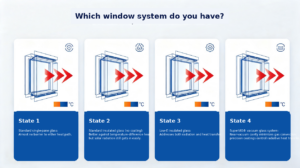
State 1: Standard single-pane glass
There is almost no barrier to either heat path. In summer, the indoor temperature follows the outdoor temperature, and the AC is essentially “fighting the entire outside environment.”
State 2: Standard insulated glass (no coating)
It improves resistance to heat transfer caused by temperature differences, but provides little control over solar radiation. Under direct summer sun, the interior can still heat up quickly.
State 3: Low-E insulated glass
It begins to address both paths at the same time. How well it performs depends on the coating type, cavity design, and the overall performance of the window-frame system.
State 4: SuperVIG® vacuum glass system
Its near-vacuum cavity nearly eliminates gas convection as a heat-transfer path. Combined with precision coatings that control radiative heat transfer, it addresses both paths more thoroughly.
This article has one key takeaway
Before choosing windows and doors, first understand the two ways heat gets in. Then look at the specifications and compare products.
It’s not simply that thicker glass is better, more panes are better, or a higher price means better performance.
What matters is whether the window can effectively address both direct solar exposure and heat transfer caused by temperature differences.
In the next few articles, we’ll break down insulated glass, vacuum glass, and window-frame materials one by one, then put them back together into a complete framework for choosing windows and doors.
If you’re renovating or selecting windows and doors for a project, tell us your city, building type, and window orientation. SuperVIG® can help you perform a “heat diagnosis” to see what state your windows are actually in.