
The Window Frame Sets the Lower Limit for Whole-Window Thermal Performance—SuperVIG Explains How to Choose and Match the Right Frame
There’s a particular kind of regret when choosing windows and doors:
You carefully selected the glass—Low-E, insulated glass, even SuperVIG vacuum glazing.
But after moving in, the area near the window frame still feels noticeably cold, and in winter, condensation forms around the frame. The overall comfort falls short of expectations.
The problem isn’t the glass. It’s the frame.
How Big Is the Difference in Thermal Conductivity Between Frame Materials?
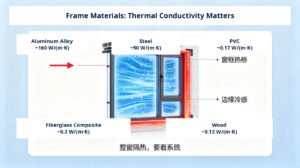
Let’s start with some data. Here are the thermal conductivities of different window-frame materials:
| Material | Thermal Conductivity W/(m·K) |
| Aluminum alloy | approx. 160 |
| Steel | approx. 50 |
| PVC | approx. 0.17 |
| Wood | approx. 0.13 |
| Fiberglass composite | approx. 0.3 |
The thermal conductivity of aluminum alloy is about 940 times that of PVC and about 1,230 times that of wood.
This means that, for the same window, heat can travel through an aluminum frame nearly a thousand times faster than through a PVC frame.
Heat travels rapidly along an aluminum frame, creating a pronounced cold zone around the frame in winter or a hot zone in summer—this is the “thermal bridge effect.”
Thermal Bridging: Where Heat Likes to “Take a Shortcut”
A thermal bridge is an area in a building envelope where heat bypasses the insulation layer by traveling directly through a highly conductive material.
The window frame is one of the areas most prone to thermal bridging for three reasons:
First: Frame Materials Are Often Highly Conductive
Aluminum alloy is one of the most common frame materials, but it has very high thermal conductivity.
Second: The Frame May Cover a Small Area, but Its Share of Heat Loss Is Not Small
In whole-window thermal analysis, the frame may account for only a small portion of the total window area, yet its share of total heat loss is often higher than expected—especially in winter and in environments with large temperature differences.
Third: The Frame Is a High-Risk Area for Condensation
The frame surface can be cold, and when it encounters humid indoor air, condensation can form easily. Condensation is not just an aesthetic issue; over time, it can damage the frame and surrounding wall.
铝合金框(含断桥铝)
- Thermally Broken Aluminum: A Mainstream Solution, but Not the Final Step
- Thermally broken aluminum uses an insulating strip between the aluminum profiles to “break” the connection between the interior and exterior sides, preventing heat from traveling directly through the aluminum frame.
PVC塑钢框
- This is currently the mainstream high-performance frame solution. It strikes a relatively good balance between the strength and mature manufacturing processes of aluminum and thermal performance.
- But thermally broken aluminum is not the end of the story:
- The quality of the thermal break varies widely.
The material of the thermal break (PA66 reinforced with fiberglass, PVC, etc.), its width (14 mm, 24 mm, 34 mm, and so on), and how it is integrated with the aluminum profile all affect actual thermal performance. Thermally broken aluminum products on the market vary considerably in quality. The name may be the same, but the performance can be very different.
- Even high-quality thermally broken aluminum has much higher thermal conductivity than fiberglass composite frames.
For projects pursuing extremely high energy efficiency, the performance ceiling of thermally broken aluminum can become quite apparent.
- Where Different Frame Materials Work Best
- Aluminum Frames (Including Thermally Broken Aluminum)
- Advantages: High strength, mature manufacturing processes, modern appearance, and easy maintenance.
• Best suited to: When paired with high-performance glass and a well-designed thermal-break structure, aluminum frames can deliver good whole-window performance. Thermally broken aluminum is a practical choice for most residential and commercial projects.
PVC Frames
• Advantages: Low thermal conductivity, naturally good insulation, and relatively low cost.
• Considerations: Structural strength, long-term weatherability, and compatibility with the glazing system.
• Best suited to: In residential applications, pairing PVC frames with SuperVIG vacuum glazing can deliver a high level of whole-window thermal performance.
Fiberglass Composite Frames
- Advantages: Combine strength with low thermal conductivity. Thermal conductivity is about 1/500 that of aluminum alloy, while weather resistance and dimensional stability are better than PVC.
• Best suited to: Paired with SuperVIG vacuum glazing, they are particularly suitable for high-performance projects such as Passive House and near-zero-energy buildings, and are among the preferred frame materials for high-performance window and door systems.
Solid Wood Frames
- Advantages: Low thermal conductivity and a natural, premium appearance.
• Considerations: Higher maintenance costs and the need for careful craftsmanship to ensure weather resistance.
• Best suited to: High-end residences, villas, and other applications where both quality and aesthetics are important. - Whole-Window U-Value Is Not the Same as Glass U-Value
- This is an important concept that is often overlooked.
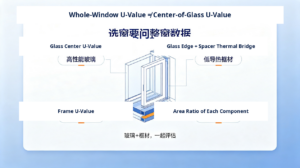
- Whole-window U-value ≠ center-of-glass U-value
Calculating whole-window U-value requires considering:
- U-value at the center of the glass.
• U-value at the glass edge, affected by spacer thermal bridging.
• U-value of the window frame.
• The area ratio of each component. - In real projects, the frame typically accounts for 20%–30% of the total window area. If the frame U-value is high, it can significantly increase the whole-window U-value.
- For example:
- Center-of-glass U-value: 0.8 W/(m²·K) (SuperVIG vacuum glazing)
• Standard thermally broken aluminum frame U-value: approx. 2.0 W/(m²·K)
• Whole-window U-value: potentially 1.2–1.5, far higher than the glass alone
That’s why SuperVIG provides frame-material matching recommendations along with its products—to ensure that the performance advantages of the glass are not offset by the window frame.
Passive House Whole-Window U-Value Requirement: ≤ 0.8 W/(m²·K)
This is a highly useful benchmark.
Passive House requirements for whole-window U-value are typically ≤ 0.8 W/(m²·K), which means:
- The glazing must use high-performance vacuum glazing or multi-chamber insulated glass.
• The frame must use a low-conductivity material, such as fiberglass composite or high-performance thermally broken aluminum.
• Warm-edge spacers must be used at the glass edge. - This benchmark represents one of the highest performance requirements in the window and door industry and is also one of the important application scenarios for SuperVIG vacuum glazing systems.
- When choosing windows, evaluate the “glass + frame” as one complete system.
The next time you review a window and door quote, remember to ask one more question: “What is the whole-window U-value, and how was it calculated?”
If the supplier can only provide glass specifications rather than whole-window data, the window design is still being approached as a “component-by-component” purchase.
Send us your current window and door configuration, and SuperVIG can help you conduct a system-level review of the “glass + frame.”